
5 Key Factors to Consider When Concerned About Cholesterol Levels
Are you on the list of people who worry about their health because of high cholesterol? Have you cut out eggs, shrimp and other high cholesterol foods including saturated fats? Perhaps you’re one of the 56 million adults in the US for whom statin use is indicated?(1) Where ever you are on the cholesterol spectrum, there are some facts you may not be aware of that could be important for your health.
What is Cholesterol and why do we need it?
Cholesterol is a waxy, fat like substance produced by your body. In fact 80% of all cholesterol is made by the body while 20% comes from the food we eat. Cholesterol is found in every cell of your body as a building block of cell membranes, providing flexibility and allowing lipids to actually pass through the membrane. Cholesterol is needed to make Vitamin D, hormones and fat dissolving bile acids. These all have a direct effect on immune function, detoxification, blood sugar regulation, mineral absorption, metabolism and reproduction.
Because cholesterol cannot cross the blood brain barrier, 25% of the body’s total cholesterol is found and produced in the brain. It protects the axons of nerve cells facilitating quick transmission of electrical impulses. This has a big impact on thought, movement, and sensation.
Types of Cholesterol
If you wondered why HDL is “good” cholesterol and LDL is “bad” cholesterol, it all boils down to delivery! Cholesterol is a fat that does not mix well with blood, similar to oil and water. In order to carry cholesterol and other fats to various cells they must be packaged with protein carriers known as lipoproteins. There of 5 different lipoproteins that vary in shape and form depending on the task at hand.
1. Chylomicrons are made in the intestines. They mainly carry
triglycerides or fatty acids from the break down of your food to cells for absorption.
- Very-low-density lipoproteins (VLDL) also carry triglycerides but they are produced in the liver. As they give up their triglycerides to cells they become IDL’s and eventually LDL particles.
- Intermediate-density lipoproteins (IDL) are intermediates between VLDL’s and LDL’s. Some IDL’s are removed by the liver for excretion and others are converted to LDL’s.
- Low-density lipoproteins (LDL) are high cholesterol containing particles because they have very little triglycerides left. They continue to travel through blood to deliver cholesterol to cells.
- High-density lipoproteins (HDL) remove cholesterol from the blood and artery walls and return it to the liver so it can be excreted.
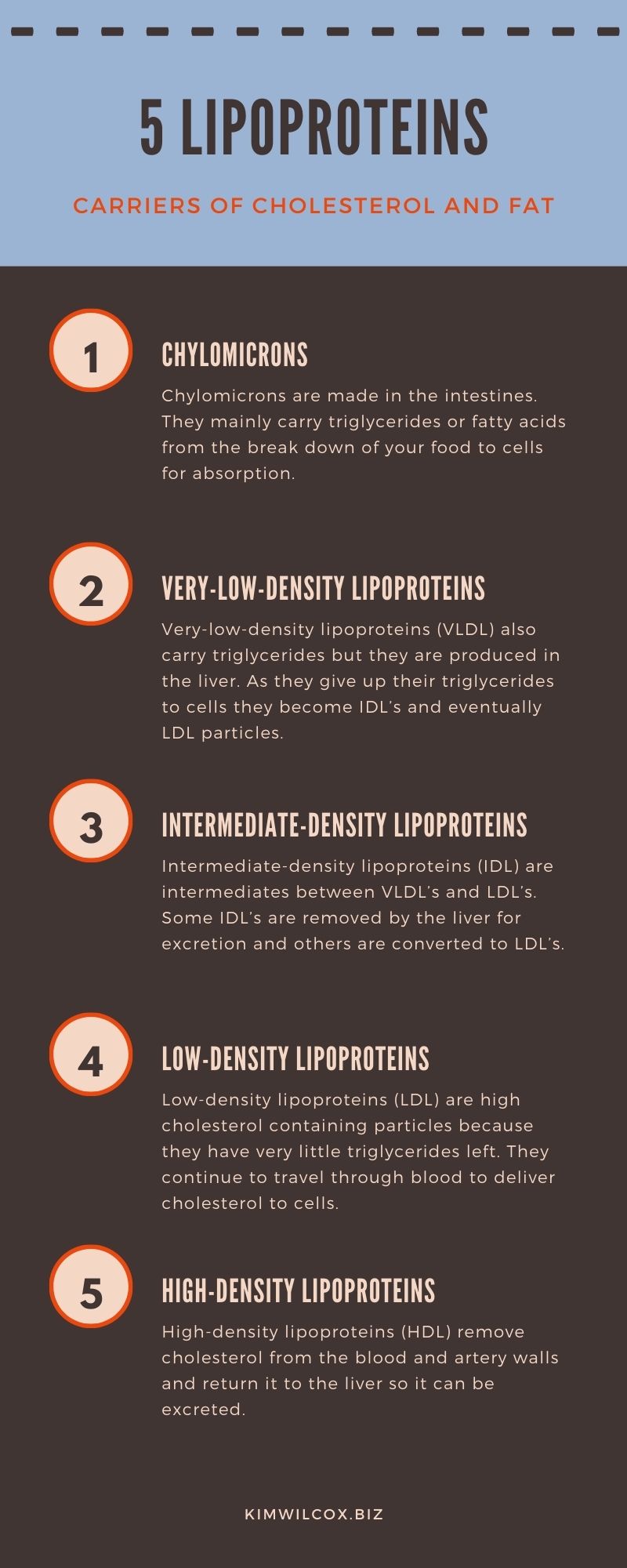
It is thought that HDL is “good” because it takes cholesterol out of the circulatory system while LDL is “bad” because it delivers cholesterol to the body and is associated with the buildup of arterial plaque.
The Nitty Gritty
While many healthcare practitioners plant red flags on high LDL and total cholesterol lab values, it has been shown that cholesterol is not correlated with hardening arteries (atherosclerosis) and the build up of arterial clogging plaque.(2) In 1936, researchers Landé and Sperry concluded that the degree of aortic atherosclerosis at autopsy of healthy individuals who had died violently, was independent of their blood cholesterol concentration analyzed immediately after death. This lack of correlation between LDL cholesterol and total cholesterol and the degree of atherosclerosis has been repeatedly confirmed by recent additional studies.
Unfortunately, the conclusion from the “Seven Countries” study by Ancel Keys in 1970 finding a significant association between fat and saturated fat intake and heart disease mortality fueled the campaign against saturated fat and cholesterol.(3) Additionally the 1984 statement ’The more LDL there is in the blood, the more rapidly atherosclerosis develops,’ by Nobel Award winners Michael Brown and Joseph Goldstein, thereafter dominated research on atherosclerosis.(4) These events lead to recommendations in 1961 by the American Heart Association to decrease intake of saturated fat and high cholesterol foods and in 1987 the FDA approval of statins, a cholesterol lowering drug.(5)
Since 1987 tens of millions of individuals use statins to control cholesterol. Yet our population continues to suffer from heart disease. Perhaps the conclusions of Lande and Sperry in 1936 should be more highly considered. Although the use of statin drugs does help decrease the incidence of heart attacks, it is likely not due to it’s cholesterol lowering effects, rather some other effect that is not absolutely understood. Inflammation and irritation of the artery wall trigger the build up of cholesterol and calcium plaques, similar to a scab, that harden arteries. It has been theorized that smoking, lack of exercise, stress and obesity are the culprits and statins have some anti inflammatory effects.(6)
This completely changes the way we view cholesterol, treatment for high cholesterol, and high cholesterol foods and saturated fats in the diet! In fact the campaign against cholesterol has effectively stifled knowledge of how extremely beneficial cholesterol really is for the body! With this in mind consider these 5 key factors concerning cholesterol:
- Statins have side effects that are downplayed due to the apparent “benefit” of the drug in lowering cholesterol. These side effects include headaches, difficulty sleeping, gastrointestinal issues, muscle pain, severe confusion or memory impairment, fatigue and new onset of Type 2 Diabetes. (7)
- The USDA (United States Department of Agriculture) recently published new dietary guidelines indicating “cholesterol is not considered a nutrient of concern for over-consumption.”(8) Clearly cholesterol is produced in the body and needed for critical biological functions.
- Focus on a healthy diet to decrease heart disease. Avoid processed foods and sugar, eat more fiber and choose healthy fats. Remember to drink plenty of water.
- Get more exercise. This is one of the best things you can do to increase HDL and decrease LDL. It also helps control blood sugar, manage stress and excrete toxins, all of which contribute to better heart health.
- Eat more vegetables. These are high in antioxidants which help decrease inflammation, high in fiber to help excrete toxins and cholesterol, and they feed your gut bacteria which play a role in cholesterol balance and metabolism.
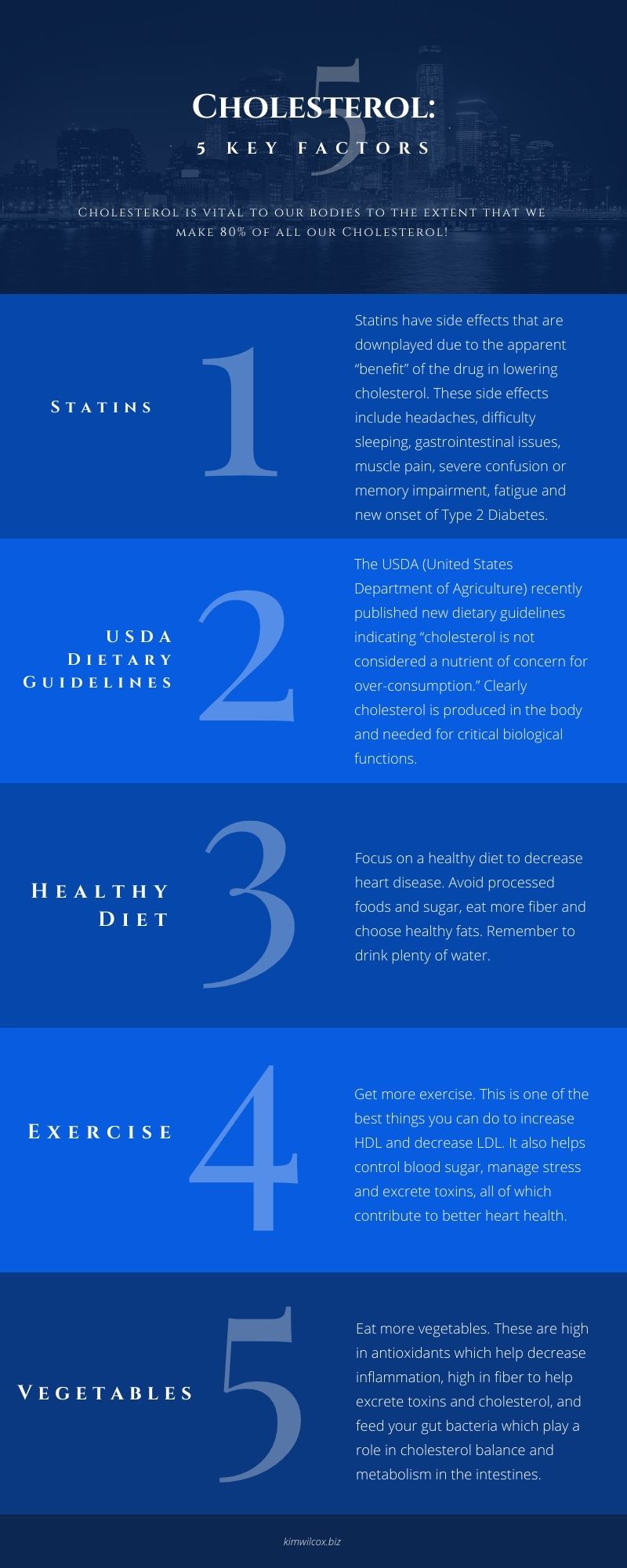
In conclusion, cholesterol is vital to our bodies to the extent that we make 80% of all our cholesterol. Statins may help decrease heart attacks but have little correlation to lowering cholesterol while their side effects are dramatic. Diet, exercise and managing stress are important and effective alternatives to controlling heart disease. Understanding these nitty gritty details can direct you on a path to better health and optimal heart health!

by Kim Wilcox MS, RDN, IFNCP
Kim helps people with chronic health issues to heal through proper diet, nutrition, stress management and environmental control. She is especially vested in helping cancer survivors overcome the odds of relapse and recurrence through her Vitality 10 program for cancer survivors!
References:
- https://jamanetwork.com/journals/jamacardiology/fullarticle/2583425
- https://academic.oup.com/qjmed/article/95/6/397/1559536
- https://academic.oup.com/jn/article/128/2/449S/4724049
- Brown M, Goldstein JL. How LDL receptors influence cholesterol and
atherosclerosis. Sci Am1984; 251:58–66.
5. https://www.clinicalcorrelations.org/2019/01/11/on-the-history-of-statins/ 6. https://jamanetwork.com/journals/jamacardiology/fullarticle/2583424
7. https://www.drugs.com/medical-answers/side-effects-statins-3439483/ 8. https://www.dietaryguidelines.gov/sites/default/files/2020-12/ Dietary_Guidelines_for_Americans_2020-2025.pdf